Comparing Fenway vs. Safeco much like comparing Boston vs Seattle


On Friday, July 11th I was lucky enough to take in my very first Red Sox game at Fenway park here in Boston.

I’ve attending many games at Safeco field in Seattle, but going to a different ballpark truly was novel.

I’m still pretty excited thinking about my experience a week later, and have described the evening at Fenway to a number of my peers back west. I got into the habit of comparing the evening to an evening at Safeco, and I started to realize that comparing my first couple weeks in Boston to my time spent living in Seattle. Both (Fenway and Boston, Safeco and Seattle) are absolutely amazing, stunning, and beautiful cities and ball parks in their own rights. A lot of people could argue they are tops in the league and country. Here’s my take on Fenway and Boston, and how it compares to Safeco and Seattle.

1. Everything seems so tight and confined, at Fenway.

Fenway is small. Seating capacity, I would guess, would be around 38,000. It’s crammed full, a sell out every evening. The walkways are full of fans, herded together like cattle on their way to their seats. The space between these seats is similar to that found between seats on an airplane.

Safeco, while a quaint ballpark itself, is much more spread out. The 38,000 that attend the typical game are sprinkled amongst nearly 50 thousand seats, resulting in a much more spread out feel.

I very much get this closed in, confined feeling traveling around Boston. The turnpike is narrower (but with as many cars), the subways are shoulder to shoulder, the streets themselves seem to be even more crammed with commuters than the massive I5, 405, or 520. Maybe it’s just me, but Seattle, as a result of all of the hills, trees, lakes, ponds and inlets, just seems so much more spread out.

2. The second I set foot inside Fenway, it felt like I’d walked back in time.

Fenway is old, creaky, and smells a little musky, much like you’re granddads house.

Safeco was designed (like all stadiums built in the 1990’s) to feel like an old ball park. It does great job of this for the most part, deep down you know you’re in a new park. That’s the price you pay for some of the luxuries of cushioned seats, wider aisles, and elevators that take you to upper levels.

While Seattle has it’s definite touch of history (especially walking around Pioneer Square), there’s no denying Boston’s place in American history.

3. There’s an unmistakable touch of attitude in the air in Fenway.

It just so happened that our seats were exactly in the middle of the isle. Of course because of this and the fact we showed up at the game late, there was much ado when we arrived, and forced people to stand up. For the rest of the game, my friendly seat neighbors, when not harassing the Baltimore batter or pitcher, would remind me about making them get up to let us in. This was always followed by saying that it could all be made up by “picking up a dozen beers for the row.”

It seems cliché stating that Seattlites and Mariner’s fans seem a bit more laid back, but it truly feels like they’re too busy instant messaging on their phones, browsing the web on their iphones, checking their Microsoft stock, to worry about harassing their opposition or their aisle neighbors.

4. Deciding what to eat really was deciding on how long of a hot dog I would get.

Fenway celebrates baseball, as baseball has been celebrated for a hundred years. This means that when I go up to buy dinner at the park, I can buy, a hotdog, a lukewarm pretzel, peanuts, and if I’m lucky a big slab of greasy pizza. No low fat, low calorie, no meat option. That’s a far cry from the Ichiroll (that’s a sushi roll), cashew cicken stir fry, Mexican Burito, or Salmon sandwhich that I can get at Safeco. Boston definitely has it’s share of ethnic restaurants, but in my 2 weeks here I’d say that the pizza and submarine sandwhich shops outnumber the Thai, Chinese, and sushi restaurants 5 to 1. In Seattle, I’d say it’s exactly opposite.

Obviously this is hardly scratching the surface of the differences between the cities (I’m sure the cuisine is the least of which any detailed comparison would discuss). However, any comparison, by it’s very nature is highly subjective. And for a kid who is still excited about his first Red Sox game, this seemed to resonate the obvious differences.


Why Edmonton is Deadmonton for Technology Startups


I love Edmonton. It’s a beautiful, friendly, family oriented city that I owe a lot to. I landed my first job here, gained countless amazing friends, and will always think positively about the city. But at the risk of sounding like a pre-madona, it’s a terrible place to be if you’re starting up a technology company.

I’ve bounced between Seattle and Edmonton the last 3 years in an attempt to balance a career, a software startup company, and a relationship; probably compromising all 3 fronts instead of fully investing. My assertion has always been that being in Seattle or San Francisco as a founder of a software startup is extremely advantageous

I’ll spare you the chest pounding rhetoric, and just give you the personal first hand challenges founding a company while spending time in Edmonton.

1. It’s expensive
Sure, web 2.0 startup costs are much cheaper than traditional models, but we experienced the expenses of Edmonton’s remoteness on a recent business trip. Since I was in Seattle at the time, I flew Seattle to San Francisco for $200 return. My co-founder flew Edmonton to San Francisco for $650 return. It also took him 6 more hours to get there.

2. Bootstrapping possibilities
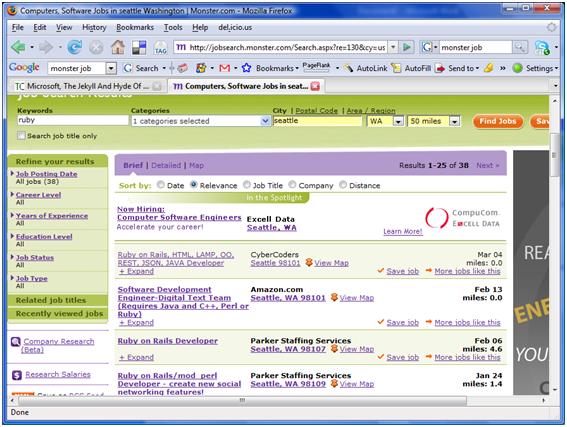
When considering venture capital investment, our team considered continued funding through independent contract work. Finding contract work in Edmonton is tough. Government contracts do exist, but to be frank, it’s not always the most invigorating work. The following is a screenshot of the “Ruby” jobs listed in Seattle Area

… and Edmonton Area.

nuff said …

3. Finding Capital
We got lucky and raised money on a cold call early on in our efforts, so this claimed advantage is based more on assumptions than first hand experience. In our early planning, we always assumed we would have to hit the east coast, Seattle, or the Valley for Angel investment or Venture Capital; perhaps I’m wrong on my assumption.

My assumption is that Edmonton is filthy rich, but the money is tied up in Oil. Edmonton’s rich are Oil millionaires. They know the industry, understand it, believe in it, and trust their investments in it. I don’t blame them. Talking, and getting helpful investment from an ex Amazon, Web-Ex, Microsoft, Google, or Oracle millionare is much easier than a Talisman, or Husky Oil. Furthermore, investment is more than just $$, and the sweat equity gained from someone who understands the business is extremely valuable.

4. Talking to startup and technology peers Talking to peers in any professional domain is energizing. Physicians, lawyers, educators, laborers, are all motivated, educated, and energized talking shop with peers. Forget networking, schmoozing, or any other cliché, there hasn’t been a Seattle Tech Startup, Seattle lunch 2.0, or startup weekend that I’ve not been incredibly motivated by. Seattle offers events sponsored by Npost, Northwest Entreupreneurs, Startpad, Seattle Tech Startups, Biznik, Seattle Lunch 2.0, and many more. No such technology evens exist in Edmonton, and I can’t help but feel incredibly isolated in Edmonton.

5. Finding evangelists We’re very close to releasing Beta product. In addition to trying to find early adopters of our software via blogs, online marketing, etc, you can bet we’re going to go the grass roots route and talk to as many of our contacts as possible in an attempt to find a beach head customer. It’s a tough thing finding evangelists of new technology when they’re all bogged down with IT policy, software restrictions, as most corporate and governmental organizations are in Edmonton.

7. Finding co-workers Not sure what comes first the jobs or those qualified to perform them, but they go hand in hand. See above screenshots of Ruby jobs in Edmonton.

8. Standard of living Start hurling tomatoes Albertans …. But the *standard of living* offered by the immediate access to the Puget sound, lake Washington, Cascade Mountains, the metropolitan perks, is a convenience for someone with a demanding work schedule. Not having to drive more than 30 miles for these benefits provides a lot of the balance we all need in our lives. While Edmonton is beautiful, it’s also extremely isolated and unbelievably cold.

I’ll admit that my ability to hack away on a laptop, whether I’m in Gull Lake Saskatchewan, Seattle, San Francisco, Edmonton, or Timbuktoo, is about the same. If only starting up a tech company was as easy as typing away on a laptop.

Why I’ll no show for Seattle Startup Weekend on Sunday


The only person in complete control of what they get out of an event like Seattle Startup weekend is … themselves. For this reason it’s largely my own failure for not getting more from the weekend.

In addition, Andrew Hyde has done a good job coordinating such a phenomenal weekend full of energy, creativity, and excitement. I really do think he’s onto something with Startup weekend, and the likes of Nathan Kaiser from NPost ,and the Jott http://www.jott.com/ crew did Seattle proud.

However, I am simply not embracing the experience and won’t be heading back Sunday for the final day to see the product called SkillBit launch. Despite plenty of talented and technical people, lots of product brainstorming, marketing, bizdev discussion and a general *I’ll do anything* attitude shown by many, this in so many ways feels more like the large company atmosphere, than that of a startup.

Dev waiting for requirements, designers waiting for a product name and url, business developers drafting page long business plans, project managers scurrying around asking what they can do to help, and an odd vibe of bitterness when egos and consensus collide.

I suppose when combining 130 some odd people, this process and division of labor is both inevitable and needed. However, to me, the most appealing part of being a founder in a startup has been the lack of role definition and the abundance of overall responsibility of all the founders performing tasks spanning from bizdev to sales, to product development.

Or maybe the real reason is simpler. I’m lucky enough to have the opportunity to invest my energy and time working on my own startup that I’m passionate about, and will see the rewards of instead.

If I were to do it again, I’d take the advice of Andrew and treat it more as a community building exercise. I’d pick a role to latch onto Friday night and learn as much as possible from one of the experts in the subject area much more experienced than I … perhaps SEO …. Perhaps learning Django …. But as it was, I couldn’t tear myself away from thoughts of our own product .. and a Ruby interpreter.